Paris Trip Day 28

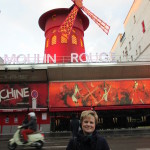
Moulin Rouge, where Henri Toulouse-Latrec found inspiration for his art.

Moulin Rouge, where Henri Toulouse-Lautrec found inspiration for his art.

Monday. My last day in Paris. I can’t believe a month has gone by already. I’m trying to savor every moment today. I’m pretty organized – I’ve reorganized my stuff enough times, I should be – so I went to buy that cute mug I saw in a shop nearby (with its own spoon!) and bought a few other small souvenirs. A guy who has a kiosk selling souvenirs at Blanche Metro had gone to his home country and came back, so I got to say good-bye to him. He asked me when I would be returning: I told him I didn’t know, but that my heart will always be here. He smiled in recognition.

I went to Champs-Elysees one last time, and took in the ambiance as much as I could. I don’t want to leave. I belong here. I wandered around taking pictures until I knew I couldn’t put it off any more. I walked to the Champs-Elysees Metro and took it for the last time to Blanche Metro. After I got off, I took some pictures of Moulin Rouge and met some travelers: one of them asked me if I wanted my picture taken. Sure! Then I walked up the Montmartre hill to Le Basilic and had dinner there again – another perfect French meal — and took a few pictures, saying my good-byes. Then I went back to Plug-Inn Hostel. I am thankful for my time here, and I’ve made a lot of connections with people, some of which I’ve forgotten to write about in my journal: my long-term memory is so much better than my short-term, that sometimes I remember things better 6 months to a year later than I did right after an experience. I still have more to say about my trip. Well, that’s something. Maybe I can even blog about it.


Salut.

Maps of France, Paris, and the Paris Metro

If you’re travelling to Paris, you’ll want to orient yourself. Here, I have provided a map of France, Paris, and the Paris Metro, and a little about them.

France

A map of France.

A map of France.

Metropolitan France is divided into 22 regions; those regions are further subdivided into 96 departments. There are an additional 5 regions (divided into 5 departments) overseas. Paris is in the Ile-de-France region (if France was a person, Ile-de-France would be located at the “heart”). Other points of interest include the area known as the South of France (southern France), Cannes, where the Cannes Film Festival is held each May, and the Pyrenees, the Alps, and the Champs-Elysees in Paris, where the Tour de France passes through and finishes.

A rider on the Les Pyrenees.

A rider on the Les Pyrenees.


Paris

A map of Paris arrondissements.

A map of Paris arrondissements.

The city of Paris is divided into 20 arrondissements (administrative districts) arranged in a clockwise spiral, often referred to as a snail shell, though it has always reminded me of The Yellow Brick Road in “The Wizard of Oz,” with the Seine River flowing east-west down the center. The spiral begins with #1 arrondissement in the middle of the city on the Right Bank (north bank) of the Seine. Paris arrondissement numbers are also the last two digits of the district’s postal code, so the 18th arrondissement’s postal code (where I stayed recently) is 75018. You will likely see signs with an arrondissement’s number displayed as Roman numerals, so the 18th arrondissement number would be XVIIIe arrondissement. There are so many Metro stations that Parisians often refer to a location referencing the closest Metro stop.

Paris Metro

The Paris Metro.

The Paris Metro.

The Paris Metro opened on July 19, 1900 during the World’s Fair. It has 303 stations, of which 62 have transfers between lines. There are 16 lines, numbered 1 to 14 with 2 lines, 3bis and 7bis, which are so named because they started as branches of lines 3 and 7. They are now separate lines. Lines are identified on maps by number and color, and direction of travel is indicated by its terminus.

You can use cash or a credit/debit card to buy tickets, which can be used for the Metro, and RER rail and buses (within the city). You can buy single tickets for 1.75 Euros, a carnet of 10 tickets for 13.30 Euros, or a Passe Navigo card for a 5 Euro fee (plus the cost of a small photo of yourself), which is a chip-embedded card similar to a SmarTrip card in the States or an Oyster card in London. The Metro tickets never expire, but it’s best to keep used tickets separate from unused, and keep your most-recently used ticket separate from all others: French police often check for gate-jumpers by asking to see your Metro ticket.  I was stopped at least twice, and the first time I panicked because I had all of my used tickets together, including my most recent one. (I don’t mean to give the impression that trashcans aren’t available. I had collected some from a full day’s sightseeing.)

Navigating the Metro is easy; the hardest part can be finding your destination on the Metro map due to the number of lines. If you start by venturing to attractions close to your lodging, you’ll get the hang of it.

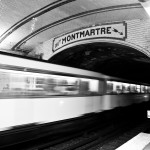
Paris Metro signs are among the most elegant in the world.

Paris Metro signs are among the most elegant in the world.


Salut.


Descriptions of maps from Wikipedia, CCBY 3.0. Maps of France, Paris and the Paris Metro courtesy of Flickr, CCBY 2.0.