Paris Trip Day 25

European cities at night via NASA satellite. It is an easy "day trip" (or night) to London from Paris.

European cities at night via satellite. It is an easy “day trip” (or night!) to London from Paris.

Friday. I woke up feeling fairly rested though my eyes were bloodshot: there’s probably mold in the hotel.

I showered, shampooed and got dressed. Then I set out for my free breakfast in the hotel. There were at least 20 people in the dining room, though few looked like they had taken a shower already. The place felt rather seedy, especially when I saw lecherous eyes look my way. I sat down at a table that wobbled, so I moved to another. One of the women working in the kitchen came into the dining room and basically asked me if I was crazy for sitting at a table for three when I was alone: “Sit somewhere else,” she told me, eyes blazing. Nothing like making paying customers want to come back! Breakfast consisted of white bread toast, butter and jam, weak coffee or tea, cheap cornflakes. It wasn’t very satisfying or particularly nutritious, but it was something to eat until I could get a piece of fruit. I tried to enjoy my breakfast at the wobbly table as I thought about the day ahead.

I went back to my room and wrote out two placards (which I had packed, rolled up, in my new French suitcase) to take with me to Buckingham Palace. After finishing them, I finished packing and did a sweep of the room to make sure I didn’t forget anything; then I walked down the 8 flights of stairs. I asked the manager if I could leave my luggage in the lobby while I was out. He said no problem, which was nice of him. I felt like my bags would be safe. Of course, having locks on my important stuff helped with my piece of mind.

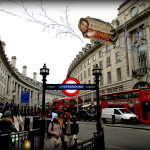
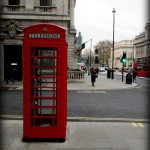
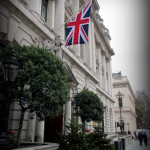
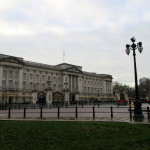
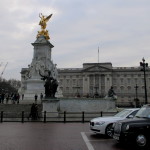
I did a little sightseeing on my way to Buckingham Palace…..

Then I held my breath and showed up at the Palace. I held up one of my signs, which essentially told Queen Elizabeth II to leave me and my family alone. Some young woman (from Ireland?) came over and asked if she could take a picture of me and my sign: “Of course,” was my response. I had been there for about 30 minutes or so when a Palace police officer came over and started asking me questions. I told him that in the States, protesting is a right, and besides, I’ve seen other people protesting at the Palace. He basically told me that if the Queen doesn’t want people protesting right outside her residence, she was within her rights to shoo them away. Then he told me I was free to protest outside the gold and black gate, yet he also continued to try to ask me questions, like where was I staying. I said, “You just said I’m free to leave and that I can protest outside the gate, am I right?” He said that was correct. “Good, I’m leaving now,” I said, and walked away without looking back. I wasn’t trying to cause an international incident: I just wanted to stand up for my family name.

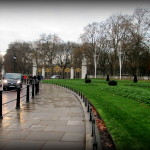
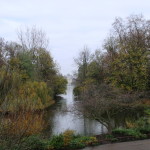
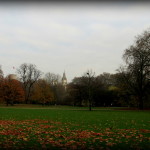
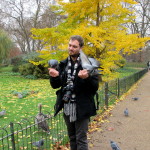
I stood at the corner he directed me to for about an hour. After I felt I had made my point, I left. It was drizzling. I went to St. James’s Park and took some pictures. Then I went to Inn the Park restaurant and warmed up, having some coffee and a dessert. It felt like a modern-day log cabin with cool lighting (and stiff seats). After I left, I threw out my placards in the trash bin near the restaurant. I felt like I had made my point. After seeing Palace police mill about as soon as I showed up, I couldn’t wait to get back to France, where I belong.

I went back to the hotel to retrieve my luggage, and thanked the management of The Continental Hotel for their service. Their hotel may not be the best, but they treated me okay, so all in all it wasn’t a horrible experience to stay at their hotel. I hope they….how shall I say?….do a little redecorating.

Victoria Coach Station was dark and cold, with almost no place to sit or stand.

Victoria Coach Station was dark and cold, with almost no place to sit or stand.

I made my way to the bus station with a light rain falling. It was absolutely freezing in the bus station. People who worked there told me they had to leave the doors open (to the buses), even though no one was boarding. I went to wait in another part of the station. I struck up a conversation with an English woman who seemed nice enough, but she started asking me questions that were none of her business, like whether I owned the house I was living in, how could I afford to take this trip, and do I have money to get home. I wanted to tell her to bugger off. I wondered who was more tactless: the Englishman who was determined to get on The Tube sooner than me, and basically pushed me out of the way, or this woman, who wouldn’t know what boundaries are if they bit her on the nose? Ahh, travelling. You meet so many kinds.

I decided to que up in line since it was nearing boarding time (finally!). A guy behind me spoke to me, and he came to understand I had only been in London for 24 hours. He asked me which country I liked better: I told him, hands down, nothing beats France. I was hoping to sit next to him just to know I would be sitting next to someone friendly, but we boarded too late to be seated next to one another. I ended up sitting behind a couple who seemed to enjoy the idea they were giving me and others a show with their French kissing. They did it so much I felt like a voyeur. I completely get that many people aren’t hung up on showing a little Public Display of Affection, but it can get to a point where you want to say, “Get a room, already!” Some people behind me where shaking their heads and smiling: they knew what I was thinking.

We arrived at the ferry and were told to remember where we had parked. (I had to laugh: they made it sound like we were parked in a mall.) The inside of the ferry was nicely appointed, with leather and other types of seating, and places to buy something to eat and drink, though I was much too tired to do either. The young people (hehhehhehheh) were all so excited, many of them drank and ate and whooped it up. No thanks. Like many others, I curled up on a sofa for the trip, which was over before I knew it. I couldn’t believe how trashed the ferry as we were exiting: it was worse than any New Year’s Eve party I had ever been to. I felt groggy when I first got up but then adrenaline kicked in: I couldn’t find my bus. Someone seemed to know which one I was looking for and helped me find my way to it.

I was much relieved when I started to see signs in French again while on the bus back to Paris from London.

I was much relieved when I started to see signs in French again while on the bus back to Paris.

As the bus drove into Paris I and I saw signs in French again, I was so relieved. Nothing beats France. I felt like I had been in enemy territory in London (though I have no beef with British people in general, only with the Queen), and now I’m back “home.” The bus let us off at a bus station that was a bit of a walk to a metro station, but I couldn’t care a less. I was SO GLAD to be back in Paris. I got back to the hostel in no time. I ate my delicious French breakfast and went to bed, happy that I had made my point.


Salut !


Images of European cities at night and bus back to Paris by Can Stock Photo. Image of Victoria Coach Station by xjy, Flickr, CCBY 2.0. All other images by Elsa L. Fridl

Paris Trip Day 24

Eurostar trains look similar to this. It was very, very cold inside the train.

Eurostar trains look similar to this. It was very, very cold inside the train.

Thursday. My travel day to London. I woke up with severe pain in my chest: it was so bad, it felt like a 2-ton cannon was on top of me. It was hard to move and even breathe. I felt like I was 90. I know full well that it isn’t a coincidence that the day I leave for London to protest at Buckingham Palace I wake up with severe pain that I have never experienced before.

I made 2 vegetable salad sandwiches for my trip, put my luggage in my new room (I have to move AGAIN!), and set off for Gare du Nord, the train station. I’m glad I got there a lot earlier than the woman at the station told me when I went to find out what to do: she said to be at the station 15 minutes before departure; had I done that, I never would have made it to my train in time. Although I had time to sit down, it took a while to go through U.K. Border Control and Security. I was given a hard time because I didn’t know where I would be staying in London. I actually thought they weren’t going to let me go. I asked the Border Patrol Officer, “Don’t people backpack through Europe all the time without knowing where they will be staying?” He told me they can always give an address where they’ll be staying in London. I find that hard to believe. Good thing I had brought my ticket (electronic) for my flight back to the States: they wanted to know when I would be leaving Europe. That information seemed to satisfy them that I wasn’t going to London for some nefarious purpose. (And no, I don’t think peacefully protesting is in any way nefarious.)

U.K. Customs nearly didn't let me proceed to London from Paris because I didn't know where I would be staying in London.

U.K. Border Control nearly didn’t let me proceed to London from Paris because I didn’t know where I would be staying in London. I was relieved when they finally stamped my passport.

I found my train car without too much trouble. I had a chat with a British woman sitting next to me, and Indian-Americans sitting across from me (from New Jersey). It wasn’t a bad trip on Eurostar – 2 ¼ hours. But the car was freezing! And I mean, really, really cold. I was so glad I wore as many layers as I did. I don’t get cold that easy, but my hands were so cold I couldn’t easily hold my phone. I will say the trip was tiring. People mostly drifted off to sleep. I’m surprised a few didn’t die of hypothermia! When I worked at night, management kept the work floor very cold in an attempt to keep employees awake; maybe the same principle was being applied here, only to an extreme.

This is about how I felt coming out of the London Underground: grey and out of focus.

This is about how I felt coming out of the London Underground: grey and out of focus.

At the train station in London I bought a couple of books on London and used those as my starting point to find a place to stay. I went to get on the London Underground when I saw an Underground employee milling about to help travelers; he told me the Underground is transitioning to having all travelers use an Oyster Card (similar to our SmarTrip Card in Washington, D.C.). Talk about expensive! When I mentioned this, he told me most travelers stay for a week, at least, so it doesn’t seem so much. I got on the Underground shaking my head in disbelief.

I had to walk up 8 flights of stairs similar to this with my luggage to get to my room in the Continental Hotel.

I had to walk up 8 flights of stairs similar to this with my luggage to get to my room at the Continental Hotel.

The first thing I saw when I emerged out of the Underground was that it was raining (naturally). I asked a smiling bobby how to get to the hotel I had picked out. He advised me not to go there because it was in a “rough area.” He pointed me in the general direction of better places to stay. He was nice, very helpful, and had beautiful blue eyes. I wished I could have talked to him longer, but I waved good-bye. I asked a guy with a pedicab (like a rickshaw) if he knew of a place to stay, and he told me about the Continental Hotel. I climbed into his pedicab and and we set off to find it. It took a while. He was generous with his time in helping me, and I was sorry I couldn’t give him more money (he told me I could pay him what I had on me). I felt like I was being watched over, but in a good way this time. The Continental Hotel is close to Paddington Station and looks nice from the outside, but is pretty ratty inside (first impression: the carpet needed to be replaced), but all I wanted was a roof over my head at a cheap price. I was horrified to find dead bugs on the bed, underneath the bedspread. I turned the mattress over and didn’t find any sign of bugs, so I just cleaned off the bed and let that be that. The bathroom containing the shower was clean enough, which I had noticed during a moment of rest on my way up about 8 flights of stairs to my room. (They don’t have a lift!) My bathroom in my room containing a toilet and sink was spotless, at least. I tried to read the faded notices on the back of my room’s door, and I gathered they used to be a hostel and are still transitioning to be a hotel. In my opinion, they still have a ways to go.

Victoria Station, London. There is a marked path on the floor of Victoria Station to lead you to the bus station, though it isn't visible here.

Victoria Station, London. There is a marked path on the floor of Victoria Station to lead you to the bus station, though it isn’t visible here.

After putting down my luggage in my room, I went to find the bus station, so I got back on the Underground to Victoria Station. When I emerged, it was dark and raining, and I thanked my good sense for not bringing my luggage with me. The traveler I had met at Plug-Inn told me the bus station was “right in” Victoria train station. Um, she exaggerated. I had A LOT more walking to do than I could have imagined. I asked an official how to get there, and he told me to follow the marked path on the floor of Victoria Station. (Inwardly I laughed: all I could think of was, “Follow the yellow brick road!”) I was led outside and followed signs there; the bus station was many blocks away on the other side of the street. I bought my ticket for my bus ride back to Paris — which was a lot more than I was told (the traveler I had met probably bought her ticket a month in advance, which I didn’t consider) — and I sighed a huge sigh of relief: one less hassle to worry about. It pays to be pro-active and get travel arrangements out of the way ahead of time. (Note: I have a specific reason for not completely planning my excursion to London ahead of time, which I’ll keep to myself.)

Americans blast McDonald's at home for its nutritional value, but while in Europe, the Golden Arches is often a welcome sight. Besides, European McDonald's are so classy, inside and out.

Americans blast McDonald’s at home for its nutritional value, but while in Europe, the Golden Arches is often a welcome sight. Besides, European McDonald’s are so classy, inside and out. This picture was taken in Milan, Italy.

I then made my way back to the hotel but decided to go to McDonald’s first and get a sandwich. They were just as busy as the McDonald’s restaurants in the States. (No surprise there.) By the time I got back to my room, I was exhausted, and my feet were killing me. I watched a few episodes of Big Bang Theory – I’ve never seen it at home – and turned out the light at about 9:30 P.M., my usual time. I’m nervous about tomorrow, so I’ll write my placards when I’m fresh in the morning.


Salut !


Image of Eurostar train by Can Stock Photo. “Isabel Ingram’s 1927 passport,” by Ken Mayer, Flickr, CCBY 2.0. Image of double decker bus by Elsa L. Fridl. “Stairs,” by martingreffe, Flickr, CCBY 2.0. Image of McDonald’s, “Restaurant Golden Arch,” by Birger Hoppe, Flickr, CCBY 2.0. “London, Victoria Station,” by fkwiatkowski, Flickr, CCBY 2.0.

Paris Trip Day 11

A rainy day in Paris is better than a sunny day anywhere else.

A rainy day in Paris is better than a sunny day anywhere else.

Friday. I feel awful. My head is stuffed. My eyes are watering like crazy. I have to stay in I feel so sick. Thank goodness the hostel has a great coffee machine. Even though I enjoy a good cup of cappuccino, the machine’s cappuccino is pretty good, especially for 1 euro. As I’ve said, a bad day in Paris beats a good day anywhere else, any time.

Later. As sick as I was, I managed to go to Gare du Nord to find out how to get to London when I go in December. I seemed to be getting the run around…no one could tell me how to take a ferry to Calais like I did the last time I visited Paris. Finally, I got the information I needed. Then, my debit card wouldn’t work, so I had to pay cash for a 1-way ticket to Calais. Hard to believe that Wells Fargo froze my account! Even after I gave them a travel itinerary before I left the States! And the Wells Fargo representative even told me she could see my travel itinerary in my account online! And she took her own sweet time making me verify each and every transaction, as slow as growing grass.

I don’t take anti-histamines much anymore, but I had no choice today, so I got an anti-histamine from a Pharmacie. I am so glad pharmacists in France are about as knowledgeable as doctors in the U.S. when it comes to medicines. I am wiped out.

Salut !


Image by Can Stock Photo.

Terrorist Attacks in Paris: What Visitors Need to Know

Following the tragic terrorist attacks of November 13th in Paris, France, About Travel offers specific information and advice for tourists and visitors.

Source: Terrorist Attacks in Paris: What Visitors Need to Know

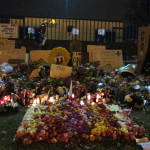
The Eiffel Tower is lit in France's flag colors of blue, white and red in memory of those slain on Friday, November 13, 2015.

The Eiffel Tower is lit in France’s flag colors of blue, white and red in memory of those slain on Friday, November 13, 2015.

Here is some information and advice from About Travel about traveling to Paris at the present time. I have summarized some points and copied other points in their entirety. If you have any questions about traveling to Paris, please complete my “Contact Elsa” form, and I will get back to you as soon as possible.

The Attacks: Main Facts
Summarizes the where and when of the attacks, police raids and investigation. Most of the attacks occurred in the 10th and 11th arroundissements, not far from the Charlie Hebdo offices.

The Aftermath in Paris: Shock and Mourning
French President Francois Hollande issued a statement in which he called the attacks “an act of absolute barbarism” and promised that “France will be ruthless in its response to [ISIS].”

But he also called for national unity and for “cool heads,” warning against intolerance or divisiveness following the attacks.

In addition, he designated three days of national mourning, so all city and state museums, schools, and public places were closed over the weekend following the attacks.

Tributes, Memorials & City Initiatives
From Monday, November 16 through Wednesday, November 18 the Eiffel Tower will be illuminated with the colors of the French flag — blue, white and red — in memory of the victims.

The city’s Latin motto “Fluctuat Nec Mergitur” — which translates to “Tossed, But Not Sunk” — is on banners all around the city, including the Eiffel Tower.

Getting In and Out of Paris/France
France’s borders have not been closed. Security has been tightened at airports, train stations, and ferry launch points, so expect significant delays.

Companies including Eurostar, EasyJet, Ryanair, Air France, and British Airways have offered free exchanges on tickets for travelers who elected not to travel to or from Paris on the day following the attacks. Call their helplines for more information.

Metro and Public Transportation
All metro, bus, and RER lines in Paris are currently running normally, with the exception of the Oberkampf metro station (line 5) which is closed, and the station St Denis (line 13), closed for security reasons due to a police raid underway in the suburb.

Closures Around the City and Bolstered Security Measures 
During the weekend following the attacks, all city and state-run museums and cultural attractions, including the Louvre, the Palace at Versailles, and the Eiffel Tower, were closed for three days of national mourning.

The Eiffel Tower is again open on Wednesday the 18th of November, after closing for security reasons on Tuesday.

On Wednesday, November 18th, all municipal and state museums and monuments were re-opened, except for the Arc de Triomphe which has not yet announced a re-opening date.

Disneyland Paris also re-opened its doors on Wednesday after a four-day closure. The Versailles palace re-opened on Tuesday, November 17th under tightened security.

Other public city events, including the annual Christmas markets and holiday lights ceremonies, were canceled in the week after the attacks. The holiday markets, including the biggest on the Champs-Elysees, were mostly open as of Wednesday, November 18th. The lit ferris wheel at the Place de la Concorde is also now open.

However, holiday lights ceremonies were postponed or cancelled around the city in the week after the attacks, including the largest lights display scheduled to kick off on the Champs Elysees, which has been postponed until further notice. Check back for updates on whether those will go forward.

In addition, many stores, shops, restaurants and bars across the capital were closed over the weekend following the attacks, in observance of national mourning. These private businesses have been re-opening at their owners’ discretion. Call ahead to verify re-opening dates and times.

For more information on current closures and re-openings of popular attractions, monuments, and museums, see this page at the Paris Tourist Office.

Official Security Advisories 
As this went to press, no advisories against visiting Paris or the rest of France have been issued by the embassies and consulates of English-speaking countries. However, they do advise caution and vigilance.

The American Embassy in Paris published the following advisory to U.S. nationals visiting France on their official website: ” We strongly urge U.S. citizens to maintain a high level of vigilance, be aware of local events, and take the appropriate steps to bolster their personal security, including limiting their movements to essential activity. U.S. citizens are encouraged to monitor media and local information sources and factor updated information into personal travel plans and activities.”  You can read the rest of their advice, including on how to register with the Embassy during your stay (recommended), at their official website.

To find your own embassy or consulate and any safety advisories published there, see this page.

Is it Safe to Visit Paris? Should I Cancel my Trip? 
Personal safety is a highly, well, personal issue, and I can’t offer any hard-and-fast advice on what nervous or anxious travelers should do. It’s entirely normal to feel some apprehension after these events. Consider these points before canceling your trip to Paris.

Security is probably at its highest ever at the moment. 
Despite what you might be reading or seeing on certain cable news outlets, France does take security very seriously, and officials have successfully intercepted and foiled many attacks in the past.

Moreover, following this recent tragedy, Paris is being patrolled by unprecedented numbers of police and military personnel, especially in crowded areas, public transport, and places frequented by tourists, including monuments, museums, markets and large shopping centers. Your risks are probably lower than usual due to these heightened precautions. While government officials acknowledge that more attacks are possible, they are showing extreme vigilance and working their very best to protect the city, its residents, and its visitors.

Read related: How to Stay Safe in Paris: Top Tips
[Elsa’s Note: With the exception of the section included here, all others are a refresher, such as protect yourself against pickpockets.] Especially when traveling alone, avoid areas around metro Les Halles, Chatelet, Gare du Nord and Stalingrad late at night or when the streets appear less than crowded. While generally safe, these areas have at times been known to harbor gang activity or to be the site of hate crimes. In addition, avoid traveling to the Northern Paris suburbs of Saint-Denis, Aubervilliers, Saint-Ouen, etc. after dark. Visitors to the above-mentioned areas may also take precautions by keeping a low profile and by refraining from wearing highly visible jewelry or clothing that identify them as members of a religion or political movement. As this goes to press, antisemitic and other hate crimes have been on the rise in the Paris region, but have largely been perpetrated outside the city walls.

We live in a world of complex risks, and we take those risks constantly. 
Just as you can’t guarantee that getting in your car for your morning commute to work won’t result in a car crash, or that you won’t be a victim of random gun violence at a supermarket, travel carries a degree of risk. The rather sobering truth is that terrorism knows few to no borders in our age: to fear Paris over any other major metropolis is to completely misunderstand how terrorists operate.

Life in Paris must go on…and without your help, it won’t. 
Paris is the number-one tourist destination in the world. The city needs, above all, to heal and rebound from this terrible tragedy, but without the help of tourists who contribute largely to its economic health and vibrancy, it’s not likely to succeed.


Vive la France. 


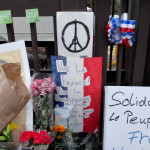
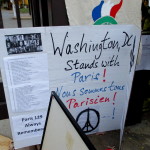
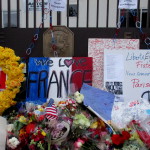
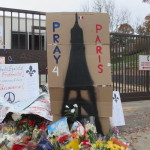
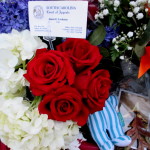
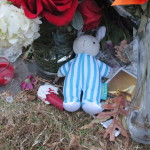
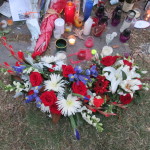
Image of Eiffel Tower lit up in blue, white and red by Yann Caradec, Flickr, CCBY 2.0. Images of Memorial at French Embassy by Elsa L. Fridl. “Peace for Paris” by Jackman Chlu, Flickr, CCBY 2.0.

Material adapted from an About Travel email dated November 17, 2015. No copyright infringement is intended. The author only means to share important safety information with travelers.


25 Paris Sites in the Movies

Paris is a beautiful city with sites to be seen for their own historical significance. But sometimes it’s fun to see sites featured in movies, either to imagine yourself in a role or to figure out how the filmmakers worked their magic at that location. Here are 25 Paris sites featured or mentioned on film, identified by arrondissement, and how to get each one.

I. M. Pei's pyramid at the Louvre is gorgeous at night.

I. M. Pei’s pyramid at the Louvre is gorgeous at night.

1. Louvre
1st arrondissement
Metro: Palais Royal-Musee du Louvre

The Louvre is the most visited museum in the world and is known by many as the home of the Mona Lisa. It was originally built as a fortress by Phillip II in the 12th century; the only remnant of the original building still visible is in the crypt. The Louvre was altered frequently in the Middle Ages, and Charles V converted the building into a residence. Francis I renovated the site in French Renaissance style, and it was his collection (including the Mona Lisa) that became the nucleus of the Louvre’s holdings. After Louis XIV chose Versailles as his residence in 1682, the Louvre was used as a residence for artists. During the French Revolution, the Louvre was transformed into a public museum.

It has been featured in many movies, of late at the beginning and the end of The Da Vinci Code (2006). I. M. Pei’s pyramid in front of the Louvre is gorgeous lit up at night.

A grieving mother is aided by a magical cowboy in a segment of Paris je t'aime.

A grieving mother is aided by a magical cowboy in a segment of Paris je t’aime.

2. Place des Victories
2nd arrondissement
Metro: Bourse, Pyramides or Etienne Marcel

The Place de Victories is a round-about (circle), located a short distance northeast from the Palais Royal and straddling the border between the 1st and the 2nd arrondissements. It is at the confluence of six streets: rue de la Feuillade, rue Vide Gousset, rue d’Aboukir, rue Etienne Marcel, rue Croix des Petits Champs, and rue Catinat. At the center of the Place des Victoires is an equestrian monument in honor of King Louis XIV, celebrating the Treaties of Nijmegen, which concluded in 1678-79. King Louis XIV negotiated the Treaty of Nijmegen which ended the Franco-Dutch War of 1672-78; this lay the groundwork for other treaties involving France, the Dutch Republic, Spain, Brandenburg, Sweden, Denmark, the Prince-Bishopric of Muster, and the Holy Empire – collectively, The Treaties of Nijmegen.

In Paris, je t’aime (2006), in a story of the same name as the arrondissement, a mother (Juliette Binoche) has a hard time accepting her son (Martin Combes) has died, and she is helped by a magical cowboy (Willem Dafoe), which her son loved. This also seems to be a commentary on French culture: In America, it wouldn’t be unusual for a mother to mourn for months, but in this segment, a father (Hippolyte Girardot) tells his wife, “It’s been a week, already.”


The beautiful garden at Square du Templar used to house the Knight Templars' palace before being torn down to modernize. On the main lawn, there is a plaque with the names of 85 children from the 3rd arrondissement deported to Auschwitz -- one of France's many memorials to those lost in WW II.

The beautiful garden at Square du Templar used to house the Knight Templars’ palace before being torn down to modernize. On the main lawn, there is a plaque with the names of 85 children from the 3rd arrondissement deported to Auschwitz — one of France’s many memorials to those lost in WWII.

3. Square du Temple
3rd arrondissement
Metro: Temple

The Knights Templar are only referred to in flash back in The Da Vinci Code. Still, they are an integral part of the story, since in Dan Brown’s storyline, they were charged with protecting a secret bloodline of Christ.

The Knights Templar were real, though Dan Brown mixed fact with fiction in his portrayal of them in "The Da Vinci Code."

The Knights Templar were real, though Dan Brown mixed fact with fiction in his portrayal of them in “The Da Vinci Code.”

In reality, they protected pilgrims in the Holy Land, and were officially endorsed by the Catholic Church. Their secret initiation ceremony created mistrust of the order and Phillip IV ordered many of the Knights Templar to be rounded up and burned at the stake on Friday, October 13, 1307. Some believe this is the origin of Friday the 13th being an unlucky day.

Notre Dame has grounds on the other side for quiet contemplation -- or for learning the one you loved loved you in return, as in "Midnight in Paris."

Notre Dame has grounds on the other side for quiet contemplation — or for learning the one you loved loved you in return, as in “Midnight in Paris.”

4. Notre Dame
6 Parvis Notre Dame – Place Jean-Paul II
4th arrondissement
Metro: Cite, Hotel de Ville, or St. Michel

Notre Dame was completed in 1345 and is among the first buildings in the world to use flying buttresses. It was built in the French Gothic architectural style.

In Midnight in Paris (2011), Notre Dame plays a supporting role, since the action doesn’t take place in its hallowed interior, but rather in the serene park surrounding the cathedral. While sitting on a park bench, a museum docent (Carla Bruni) translates a diary for Gil (Owen Wilson) written by Adriana (Marion Cotillard), a 1920s French woman he falls in love with by going back in time while visiting Paris.

Shakespeare and Company plays only a minor role in "Midnight in Paris," but like a good-looking actor who is destined to be discovered, you notice it.

Shakespeare and Company plays only a minor role in “Midnight in Paris,” but like a good-looking actor who is destined to be discovered, you notice it.

5. Shakespeare and Company
37 rue de la Bucherie
5th arrondissement
Metro: St. Michel

The original Shakespeare and Company opened in 1919 and moved in 1922. In the early 1920s, it was a gathering place for writers such as Ernest Hemingway and James Joyce. This first location closed during the German occupation of Paris and never re-opened.

The current Shakespeare and Company opened in 1951 under another name and was later renamed in tribute to the original book store.

There are lots of nooks and well-used chairs in Shakespeare and Company to curl up in and read.

There are lots of nooks and well-used chairs in Shakespeare and Company to curl up in and read.

Shakespeare and Company only plays a minor role in Midnight in Paris (a walk-by, more or less), but like a good-looking actor who is destined to be discovered, you notice it. The bookstore has lots of nooks and crannies and used chairs to curl up in and read. You can even buy a book if you want.

With such an emphasis on fresh food in France, it makes sense there would be many outdoor markets like the one on Rue Mouffetard.

With such an emphasis on fresh food in France, it makes sense there would be many outdoor markets like the one on Rue Mouffetard.

6. Rue Mouffetard
The market starts at Place Contrescarpe and ends below at St. Medard Church.
5th arrondissement
Metro: Censier Daubenton

Rue Mouffetard is one of Paris’s oldest neighborhoods, dating back to Neolithic Times. Since food – especially fresh food – has always been a national passion in France with many people shopping for food daily, it makes sense that fruit, vegetables, and meat would be sold at such street markets at their peak of freshness.

The interior shots of St. Sulpice in "The Da Vinci Code" were filmed on a sound stage. You might be surprised by how dark the interior really is.

The interior shots of St. Sulpice in “The Da Vinci Code” were filmed on a sound stage. You might be surprised by how dark the interior really is.

In Julie & Julia (2009), Julia Child (Meryl Streep) shops for groceries at rue Mouffetard where she ingratiates herself to the locals with her charm and personality.

7. St. Sulpice
2 rue Palatine
6th arrondissement
Metro: St. Sulpice or Mabillon

St. Sulpice is the second largest church in the city and is dedicated to Sulpitius the Pious, a 7th century bishop of Bourges, France. Coincidentally, the church is the second built on the site: the original was built in the 13th century. Construction of the current structure began in 1646 and took over 100 years to be what it is today.

Can you imagine being trapped in a falling elevator in the Eiffel Tower's elevator shaft?

Can you imagine being trapped in a falling elevator in the Eiffel Tower’s elevator shaft?

In The Da Vinci Code, Robert Langdon (Tom Hanks)  searches for the “Rose Line,” a fictional name given to the Paris Meridian which is marked by a brass strip on the interior floor of the church. The real exterior of the church is used, but the interior was digitally recreated in the studio.

8. Eiffel Tower
Champ de Mars, 5 avenue Anatole
7th arrondissement
Metro: Bir-Hakeim or Trocadero

The Eiffel Tower was built in 1889 to be that year’s entrance arch to the 1889 World’s Fair. It is named after Alexandre Gustave Eiffel, the engineer who designed it. Many people didn’t think the design was feasible; later, it was criticized for being an eyesore and many people called for it to be dismantled. Cooler heads prevailed. Today, it is one of the most recognized structures in the world: One cannot think of France without envisioning the Eiffel Tower.

The Eiffel Tower has played many starring and supporting roles in movies, but perhaps one of the most unforgettable is in Superman II (1980) when Superman (Christopher Reeve) saves Louis Lane (Margot Kidder) by flying under the falling elevator she’s in and hurling it into space (letting her off first!), inadvertently freeing three villains from a glass prism-jail when the elevator shatters it in space. This was a white-knuckle stunt to watch at the time.

The Pont Alexandre III is behind the Grand Palais, which is at the east end of the Champs-Elysees.

The Pont Alexandre III is behind the Grand Palais, which is at the east end of the Champs-Elysees.

9. Pont Alexandre III
8th arrondissement
Metro: Charles de Gaulle Etoile (walk down length of the Champs-Elysees to the Grand Palais, the bridge is behind it), George V, Franklin D. Roosevelt, Champs-Elysees, or Concorde

Gabrielle (Lea Seydoux) loves Cole Porter and Paris in the rain in "Midnight in Paris."

Gabrielle (Lea Seydoux) loves Cole Porter and Paris in the rain in “Midnight in Paris.”

The bridge spans the Seine River and connects the Champs-Elysees quarter with those of Invalides and Eiffel Tower. It is widely regarded as the most beautiful and most ornate bridge in Paris. It was built to celebrate a treaty between France and Russia.

At the end of Midnight in Paris, Gil (Owen Wilson) runs into Gabrielle (Lea Seydoux), a young French woman whose values reflect his own. It starts to rain while they are walking on the bridge, and she tells him she doesn’t mind getting wet, and that Paris is most beautiful in the rain. Since his ex-fiancee hated getting wet and couldn’t see the beauty of Paris, philosophically speaking, the bridge serves as a transition for Gil to follow his values and find personal happiness as a result.

The Arc de Triomphe has exquisite detail, including 6 reliefs on the facades of the Arch and 21 sculpted roses on its interior.

The Arc de Triomphe features exquisite detail, including 6 reliefs on the facades of the Arch and 21 sculpted roses on its interior.

10. Arc de Triomphe
Place Charles de Gaulle
8th arrondissement
Metro: Charles de Gaulle Etoile

The Arc de Triomphe was completed in 1836 to honor France’s war dead of the French Revolutionary and Napoleonic Wars. It was featured in The Day of the Jackal (1973) when French President Charles de Gaulle (Adrian Cayla-Legrand) rides in a parade to celebrate Liberation Day (August 25, 1944) when Paris was liberated from the Germans at the end of WWII. During filming, the actor playing de Gaulle was mistaken for the former French President – even though he had died in 1969 – causing at least one person to faint. The filming took place during a real Liberation Day parade.

Fountain at Place de la Concorde at sunset.

Fountain at Place de la Concorde at sunset.

11. Place de la Concorde Fountain
8th arrondissement
Metro: Concorde

There are 2 fountains at Place de la Concorde: the south fountain, Maritime Navigation, and the north, River Commerce and Navigation — so named because they were built in the shadow of the Ministry of the Navy.  They were completed in 1840 during the reign of King Louis-Philippe.

In The Devil Wears Prada (2006), Andy (Anne Hathaway) throws her phone into one of the fountains when she’s “done” with Miranda Priestly (Meryl Streep).

The Theatre de l'Athenee is said to be one of the most beautiful buildings in Paris.

The Theatre de l’Athenee is said to be one of the most beautiful buildings in Paris.

12. Theatre de l’Athenee (also known as Theatre de l’Athenee-Louis-Jouvet)
7 rue Boudreau
9th arrondissement
Square de l’Opera-Louis Jouvet
Metro: Havre-Caumartin, Opera; RER: Auber

 The theatre was built in 1894 from the foyer of the previous theatre on the site. It is named after Louis Jouvet, who directed the theatre from 1934 – 1951. The theatre is classified as an historical monument.

In Hugo (2011), a boy (Asa Butterfield) lives alone in a clock tower after his father (Jude Law) and then a guardian (Ray Winstone) die. The boy tries to find a key to operate a robot his father left him. A magician named Georges Melies (Ben Kingsley), who eventually helps him, performs a magic trick in the theatre.

Gare du Nord serves approximately 190 million passengers per year.

Gare du Nord serves approximately 190 million passengers per year.

13. Gare du Nord
112 rue de Maubeuge
10th arrondissement
Metro: Gare du Nord

The original Gare du Nord (“North Station”) was built in 1846. It was partially demolished in 1860 so it could expand. The station serves approximately 190 million travelers per year, making it the busiest railway station in Europe.

The Arc de Triomphe has exquisite detail, including 6 reliefs on the facades of the Arch and 21 sculpted roses on its interior.

Gare du Nord railway station is enormous by anyone’s standards.

When Jason Bourne (Matt Damon) in The Bourne Identity (2002) first arrives in Paris, he locks his duffle bag full of spy paraphernalia in a locker in Gare du Nord. I’ve been in Gare du Nord several times and I’ve never seen lockers – I would think they would be a security risk – but I’ve never looked for them, either. I’ve always been too busy getting to where I want to go, similar to Mr. Bourne.


Le Pure Cafe is said to be a "genuine bistro experience."

Le Pure Cafe is said to be a “genuine bistro experience.”

14. Le Pure Café
14 rue Jean Mace
11th arrondissement
Metro: Charonne

Le Pure Café is decorated in the Art Deco style and offers classic French dishes as well as burgers and cappuccino. It is often described as “a genuine bistro experience,” and is well-regarded by local Parisians.

Many people now associate Le Pure Café with the film "Before Sunset."

Many people now associate Le Pure Café with the film “Before Sunset.”

While Paris landmarks, like A-List stars, are easy to spot in movies, cafés often play minor roles like that of an “extra” – important to the scene, though nameless. One such café is Le Pure Café in the 11th arrondissement, in Before Sunset (2004), where Celine (Julie Delpy) and Jesse (Ethan Hawke) connect.

Le Train Bleu Restaurant, inside Gare de Lyon station, was named after a luxury train of the same name.

Le Train Bleu Restaurant, inside Gare de Lyon station, was named after a luxury train of the same name.

15. Le Train Bleu Restaurant
Gare de Lyon, Place Louis Armand
12th arrondissement
Metro: Gare de Lyon

Le Train Bleu is a restaurant built in 1901 in a hall of Gare de Lyon railway station. Initially called “Buffet de la Gare de Lyon,” it was renamed in 1963 after a luxury train of the same name that ran between Calais and the French Riviera. It is decorated in the Renaissance style with frescoes on the walls and ceilings, gilded cherubs, and light fixtures with numerous bulbs.

Le Train Bleu serves as the backdrop for Nikita’s (Anne Parillaud) first mission as a trained assassin in La Femme Nikita (1990). I fully admit I included Le Train Bleu because the décor is so gorgeous I couldn’t resist.

Avenue de Choisy, part of the Asian Quarter in Paris.

Avenue de Choisy, part of the Asian Quarter in Paris.

16. Quartier Asiatique (“Asian Quarter”)
13th arrondissement
Metro: Tolbiac, Olympiades, or Port d’Ivry

 Quartier Asiatique is roughly the shape of a triangle formed by the confluence of avenue de Choisy, avenue d’Ivry, and boulevard Massena, as well as the Les Olympiades complex. It is the largest commercial and cultural center for the Asian community of Paris.

 In the Port de Choisy segment of Paris je t’aime, a new beauty products salesman (Barbet Schroeder) runs into “sales resistance” by a salon owner (Li Xin) in Chinatown.

Doc (Roy Scheider) in "Marathon Man."

Doc (Roy Scheider) in “Marathon Man.”

Le Dome Cafe opened in 1898 and offers sumptuous seafood meals.

Le Dome Cafe opened in 1898 and offers sumptuous seafood meals.

17. Le Dome Café
108 boulevard du Montparnasse
14th arrondissement
Metro: Vavin

Le Dome Café opened in 1898, and similar to Shakespeare and Company, served as a gathering place for writers and artists on the West Bank. Today, it is said to be one of the best seafood restaurants in Paris.

In Marathon Man (1976), Doc (Roy Scheider) meets with his superior Janeway (William Devane) at Le Dome Café to talk about his concerns for his safety.


Le Cordon Bleu was closed during the German occupation of France and reopened in 1946 under the tutelage of Madame Elisabeth Brassart.

Le Cordon Bleu was closed during the German occupation of France and reopened in 1946 under the tutelage of Madame Elisabeth Brassart.


18. Le Cordon Bleu
8 rue Leon, Delhomme
15th arrondissement
Metro: Convention

Le Cordon Bleu (“The Blue Ribbon”) is one of the world’s most renowned and prestigious cooking schools. The school has its roots in La Cuisinere Cordon Bleu Magazine founded by Marthe Distel in the late 19th century. The magazine featured cooking lessons by some of the best chefs in France. Le C0rdon Bleu opened in 1895 but closed during the German occupation of France (1940-1944). Madame Elisabeth Brassart relaunched the school in 1945 and managed it until her retirement in 1984.

In Julie & Julia, Julia famously attends Le Cordon Bleu cooking school, where she learns to master the art of French cooking.

The folding-over of rue Bouchut is a stunning special effect in "Inception."

The folding-over of rue Bouchut is a stunning special effect in “Inception.”

19. Rue Bouchut
15th arrondissement
Metro: Sevres-Lecorbe

Rue Bouchut is a quintessential Paris street due to its architecture: buildings with many stories and windows, wrought iron bars holding window boxes, and decorative molding giving the building facades definition and character. There is also a round-about at one end of the street. Perhaps it is the street’s quintessential French character that persuaded Christopher Nolan to select the location for a sequence in Inception, in which Cobb (Leonardo DiCaprio) teaches Ariadne (Ellen Page) about the dream state while they walk around Paris. While the two are talking, Ariadne folds rue Bouchut unto itself.

Rue Bouchut has a round-about at one end.

Rue Bouchut has a round-about at one end.

Unfortunately, there was construction underway on rue Bouchut when I was in Paris in the fall of 2014, so I couldn’t take my own picture. I hope you are more fortunate.

A beautiful sunset at Pont de Bir-Hakeim.

A beautiful sunset at Pont de Bir-Hakeim.

20. Pont de Bir-Hakeim
Connects 15th & 16th arrondissements
Metro: Bir-Hakeim (15th arrondissement)

The bridge was constructed between 1903 – 1905, and replaced a bridge built in 1878. Pont de Bir-Hakeim has two levels: one for motor vehicles and pedestrians, and a viaduct above for Line 6 of the Paris metro.

In Inception, Cobb (Leonardo DiCaprio) instructs Ariadne (Ellen Page) to never create dreamscapes from memory while the two walk on the pedestrian walkway. Ariadne finds out why in the form of Mal (Marion Cotillard) walking up to her and “killing” her – which wakes her up.

If you're interested in the history of fashion, the Palais Galliera is the place for you.

If you’re interested in the history of fashion, the Palais Galliera is the place for you.

21. Palais Galliera (more formal, Musée de la Mode de la Ville de Paris, “City of Paris Fashion Museum”)
10 avenue Pierre 1er de Serbie
16th arrondissement
Metro: Iena

The museum was a gift of Duchess Galliera and was built to display her family’s works of art. It was designed by Leon Ginain, who also supervised its construction. The museum formally opened in July 1894, and only has temporary exhibits, due to the delicate nature of its collections. The museum is closed between each exhibit. [Note: The museum is temporarily closed until November 2015.]

The Paris Fashion Show that Andy (Anne Hathaway) attends in Emily’s (Emily Blunt) place is held here in The Devil Wears Prada, which was strictly for filmmaking purposes.

A bird's eye view Hotel Camelia International, 17e.

A bird’s eye view Hotel Camelia International, 17e.

22. Hotel Camelia International
3 rue Darcet
17th arrondissement
Metro: Place de Clichy or La Fourche

Hotel Camelia is a budget hotel in pricey Paris. Just remember: You get what you pay for.

In Taken (2008), Bryan (Liam Neeson) finds a girl who had been taken hostage and takes her to the first safe place he can think of: Hotel Camelia, run by an old friend.

The steps to Le Basilique du Sacre-Coeur have been featured in many films.

The steps to Le Basilique du Sacre-Coeur have been featured in many films.

23. (Steps to ) Le Basilique du Sacre-Coeur
(“Basilica of the Sacred Heart of Paris”)
18th arrondissement
Metro: Abbesse

Le Basilique du Sacre-Coeur, "Basilica of the Sacred Heart of Paris" is the crown jewel of Montmartre.

Le Basilique du Sacre-Coeur, “Basilica of the Sacred Heart of Paris” is the crown jewel of Montmartre.

The Basilica is located at the summit of the butte Montmartre, the highest point in the city. It was constructed between 1875 – 1914. Being the highest point in the city means you have to climb many steps to get there: 270, to be exact.


The obelisk at Place des fetes is the site of a sad story in "Paris, je t'aime."

The obelisk at Place des Fetes is the site of a sad story in “Paris, je t’aime.”

24. Place des Fetes (above ground)
Metro: Place des Fetes
19th arrondissement

As a place, it is nearly entirely concrete, though the Square Monseigneur-Maillet, one of Paris’s oldest gardens, is nearby.

The “Place des Fetes” segment of Paris je t’aime is a sad story about a man (Seydou Boro) who dies from a stab wound while being tended by the female medic (Aissa Maiga) he is secretly in love with.

There are many feral cats at Pere Lachaise Cemetery to keep the dead company.

There are many feral cats at Pere Lachaise Cemetery to keep the dead company.

Frederic Chopin's gravesite at Pere Lachaise Cemetery.

Frederic Chopin’s gravesite at Pere Lachaise Cemetery.

25. Pere Lachaise Cemetery
20th arrondissement
Metro: Gambetta

Pere Lachaise Cemetery is the largest cemetery in Paris. It takes its name from Pere Francois de la Chaise (1624-1709), a Jesuit priest who lived on the property. Napoleon established the cemetery in 1804 and declared, “Every citizen has the right to be buried regardless of race or religion.” Few people wanted to be buried here at first due to its location (and its lack of blessing by the Catholic Church). That changed after the cemetery’s administrators decided to move the remains of Jean de la Fontaine and Moliere to Pere Lachaise; soon after, people clamored to be buried with the famous.

Frances (Emily Mortimer) and William (Rufus Sewell) are an engaged couple in a Paris je t’aime segment who argue because he cannot make her laugh. William gets a little help from Oscar Wilde (Alexander Payne) in patching things up with his fiancée.

I went for a coffee after visiting the cemetery. You might want to, too.


Au revoir!


Image credits by entry: 1) Louvre by CanStockPhoto; 2) Place des Victoires by Alex1961, Flickr, CCBY 2.0; 3) Square du Temple by David McKelvey, Flickr, CCBY 2.0; Knights Templar drawing by Steve Nimmons, Flickr, CCBY 2.0; 4) Notre Dame by NBPhotostream, Flickr, CCBY 2.0; 5) Shakespeare and Company by Elsa L. Fridl; Interior Photo by Alexandre Duret-Lutz, Flickr, CCBY 2.0; 6) Rue Mouffetard by Wally Gobetz, Flickr, CCBY 2.0; 7) St. Sulpice Church by Linus Mak, Flickr, CCBY 2.0; 8) Eiffel Tower Elevator Shaft by Linus Mak, Flickr, CCBY 2.0; 9) Pont Alexandre III by Jean-Marc, Flickr, CCBY 2.0; Photo of Lea Seydoux courtesy of Blu-ray, used by permission; 10) Arc de Triomphe by Richard, Flickr, CCBY 2.0; 11) Place de la Concorde Fountain by Christine Kalina, Flickr, CCBY 2.0; 12) Theatre de l’Athenee by Haguard DuNord, Wikimedia Commons, CCBY 3.0; 13) Gare du Nord facade by CanStockPhoto; Gare du Nord panorama by Mitch Barrie, Flickr, CCBY 2.0;  14) Le Pure Café by Bertrand, Flickr, CCBY 2.0; Image of Before Sunset courtesy of Blu-ray, used by permission; 15) Le Train Bleu Restaurant by Brendan Lynch, Flickr, CCBY 2.0; 16) Quartier Asiatique, Avenue de Choisy by Antoine, Flickr, CCBY 2.0; 17) Le Dome Cafe in the Public Domain; Image of Roy Scheider courtesy of Blu-ray, used by permission; 18) Le Cordon Bleu by Tara Tiger Brown, Flickr, CCBY 2.0; 19) Rue Bouchut by ParisRiveGauche.com, CCBY 2.0; Rue Bouchut by Mathieu Marquet, Wikimedia Commons, CCBY 2.0; 20) Pont de Bir-Hakeim by Zoltan Voros, Flickr, CCBY 2.0; 21) Palais Galliera by Panoramas, Flickr, CCBY 2.0; 22) Hotel Camelia International by Hector Parayuelos, Flickr, CCBY 2.0; 23) Steps of Le Basilique du Sacre Coeur by CanStockPhoto; Sacre Coeur by Cbarbi, Flickr, CCBY 2.0; 24) Place des Fetes by Witguide.free.fr, CCBY 2.0; 25) Pere Lachaise, Photo of Chopin’s Grave by CanStockPhoto; Cat at Grave by Daniel Racovitan, Flickr, CCBY 2.0.


Verbiage references by entry: 1) “Louvre” by Wikipedia, CCBY 3.0; “Film locations for The Da Vinci Code (2000),” by Movie-locations.com; 2) “Place des Victoires,” by Wikipedia, CCBY 3.0; 3) “Knights Templar,” by Wikipedia, CCBY 3.0; “Square du Temple” by David McKelvey, Flickr, CCBY 2.0; 4) “Notre Dame de Paris,” by Wikipedia, CCBY 3.0; “Film locations for Midnight in Paris (2011)” by Movie-locations.com; 5) “Shakespeare and Company (bookstore),” by Wikipedia, CCBY 3.0; 6) “Rue Mouffetard,” Wikipedia, for fact market dates back to Neolithic Times; 7) “Church of Saint-Sulpice, Paris,” by Wikipedia, CCBY 3.0; “Film locations for The Da Vinci Code, Movie-locations.com; 8) “Eiffel Tower,” by Wikipedia, CCBY 3.0; 9) “Pont Alexandre III,” by Wikipedia, CCBY 3.0; 10) “Arc de Triomphe,” by Wikipedia, for fact the Arc was completed in 1836 to honor France’s war dead of the French Revolutionary and Napoleonic Wars; Day of the Jackal, by Wikipedia, CCBY 3.0; 11) “Fontaines de la Concorde,” by Wikipedia, for fact that two fountains were completed at that location in 1840 during the reign of King Louis-Philippe; 12) “Theatre de l’Athenee,” by Wikipedia, CCBY 3.0; “Film locations for Hugo (2011),” Movie-locations.com; 13) “Gare du Nord,” by Wikipedia, CCBY 3.0; “Film locations for Bourne Identity (2002),” Movie-locations.com; 14) “Le Pure Café,” TripAdvisor; “Film locations for Before Sunset (2004),” Movie-locations.com; 15) “Le Train Bleu,” by Wikipedia, CCBY 3.0; “La Femme Nikita (1990), Filming locations,” IMDb; 16) “Quartier Asiatique,” by Wikipedia, CCBY 3.0; “Paris je t’aime,” by Wikipedia, CCBY 3.0; 17) “Le Dome Café,” by Wikipedia, CCBY 3.0; “Film locations for Marathon Man (1976),” Movie-locations.com; 18) “Le Cordon Bleu,” by Wikipedia, CCBY 3.0; 19) Rue Bouchut, no references; 20) “Pont de Bir-Hakeim,” by Wikipedia, CCBY 3.0; 21) “Musee Galliera,” by Wikipedia, CCBY 3.0; “Film locations for The Devil Wears Prada (2006),” Movie-locations.com; 22) “Film locations for Taken (2008),” Movie-locations.com; 23) “Sacre-Coeur, Paris,” by Wikipedia, CCBY 3.0; 24) “Place des fetes,” Witguide.free.fr; 25) “Pere Lachaise Cemetery,” by Wikipedia, CCBY 3.0.


Entries with CCBY 3.0 licenses are available under the “share and share alike” clause.


Paris Trip Day 25

European cities at night via NASA satellite. It is an easy "day trip" (or night) to London from Paris.

European cities at night via satellite. It is an easy “day trip” (or night!) to London from Paris.

Friday. I woke up feeling fairly rested though my eyes were bloodshot: there’s probably mold in the hotel.

I showered, shampooed and got dressed. Then I set out for my free breakfast in the hotel. There were at least 20 people in the dining room, though few looked like they had taken a shower already. The place felt rather seedy, especially when I saw lecherous eyes look my way. I sat down at a table that wobbled so I moved to another. One of the women working came into the dining room from the kitchen and basically asked me if I was crazy for sitting at a table for three when I was alone: “Sit somewhere else,” she told me, eyes blazing. Nothing like making paying customers want to come back! Breakfast consisted of white bread toast, butter and jam, weak coffee or tea, cheap cornflakes. It wasn’t very satisfying or particularly nutritious, but it was something to eat until I could get a piece of fruit. I tried to enjoy my breakfast at the wobbly table as I thought about the day ahead.

I went back to my room and wrote out two placards (which I had packed, rolled up, in my new French suitcase) to take with me to Buckingham Palace. After finishing them, I finished packing and did a sweep of the room to make sure I didn’t forget anything; then I walked down the 8 flights of stairs. I asked the manager if I could leave my luggage in the lobby while I was out. He said no problem, which was nice of him. I felt like my bags would be safe. Of course, having locks on my important stuff helped with my piece of mind.

I did a little sightseeing on my way to Buckingham Palace…..


Then I held my breath and showed up at the Palace. I held up one of my signs, which essentially told Queen Elizabeth II to leave me and my family alone. Some young woman (from Ireland?) came over and asked if she could take a picture of me and my sign: “Of course,” was my response. I had been there for about 30 minutes or so when a Palace police officer came over and started asking me questions. I told him that in the States, protesting is a right, and besides, I’ve seen other people protesting at the Palace. He basically told me that if the Queen doesn’t want people protesting right outside her residence, she was within her rights to shoo them away. Then he told me I was free to protest outside the gold and black gate, yet he also continued to try to ask me questions, like where was I staying. I said, “You just said I’m free to leave and that I can protest outside the gate, am I right?” He said that was correct. “Good, I’m leaving now,” I said, and walked away without looking back. I wasn’t trying to cause an international incident: I just wanted to stand up for my family name.

I stood at the corner he directed me to for about an hour. After I felt I had made my point, I left. It was drizzling. I went to St. James’s Park and took some pictures. Then I went to Inn the Park restaurant and warmed up, having some coffee and a dessert. It felt like a modern-day log cabin with cool lighting (and stiff seats). After I left, I threw out my placards in the trash bin near the restaurant. I felt like I had made my point. After seeing Palace police mill about as soon as I showed up, I couldn’t wait to get back to France, where I belong.

I went back to the hotel to retrieve my luggage, and thanked the management of The Continental Hotel for their service. Their hotel may not be the best, but they treated me okay, so all in all it wasn’t a horrible experience to stay at their hotel. I hope they….how shall I say?….do a little redecorating.

I made my way to the bus station with a light rain falling. It was absolutely freezing in the bus station. People who worked there told me they had to leave the doors open (to the buses), even though no one was boarding. I went to wait in another part of the station. I struck up a conversation with an English woman who seemed nice enough, but she started asking me questions that were none of her business, like whether I owned the house I was living in, how could I afford to take this trip, and do I have money to get home. I wanted to tell her to bugger off. I wondered who was more tactless: the Englishman who was determined to get on The Tube sooner than me, and basically pushed me out of the way, or this woman, who wouldn’t know what boundaries are if they bit her on the nose? Ahh, travelling. You meet so many kinds.

I decided to que up in line since it was nearing boarding time (finally!). A guy behind me spoke to me, and he came to understand I had only been in London for 24 hours. He asked me which country I liked better: I told him, hands down, nothing beats France. I was hoping to sit next to him just to know I would be sitting next to someone friendly, but we boarded too late to be seated next to one another. I ended up sitting behind a couple who seemed to enjoy the idea they were giving me and others a show with their French kissing. They did it so much I felt like a voyeur. I completely get that many people aren’t hung up on showing a little Public Display of Affection, but it can get to a point where you want to say, “Get a room, already!” Some people behind me where shaking their heads and smiling: they knew what I was thinking.

We arrived at the ferry and were told to remember where we had parked. (I had to laugh: they made it sound like we were parked in a mall.) The inside of the ferry was nicely appointed, with leather and other types of seating, and places to buy something to eat and drink, though I was much too tired to do either. The young people (hehhehhehheh) were all so excited, many of them drank and ate and whooped it up. No thanks. Like many others, I curled up on a sofa for the trip, which was over before I knew it. I couldn’t believe how trashed the ferry as we were exiting: it was worse than any New Year’s Eve party I had ever been to. I felt groggy when I first got up but then adrenaline kicked in: I couldn’t find my bus. Someone seemed to know which one I was looking for and helped me find my way to it.

I was much relieved when I started to see signs in French again while on the bus back to Paris from London.

I was much relieved when I started to see signs in French again while on the bus back to Paris.

As the bus drove into Paris I and I saw signs in French again, I was so relieved. Nothing beats France. I felt like I had been in enemy territory in London and now I’m back “home.” The bus let us off at a bus station that was a bit of a walk to a Metro station, but I couldn’t care a less. I was SO GLAD to be back in Paris. I got back to the hostel in no time. I ate my delicious French breakfast and went to bed, happy that I had made my point.

Salut.

Paris Trip Day 24

Eurostar trains look similar to this. It was very, very cold inside the train.

Eurostar trains look similar to this. It was very, very cold inside the train.

Thursday. My travel day to London. I woke up with severe pain in my chest: it was so bad, it felt like a 2-ton cannon was on top of me. It was hard to move and even breathe. I felt like I was 90. I know full well that it isn’t a coincidence that the day I leave for London to protest at Buckingham Palace I wake up with severe pain that I have never experienced before.

I made 2 vegetable salad sandwiches for my trip, put my luggage in my new room (I have to move AGAIN!), and set off for Gare du Nord, the train station. I’m glad I got there a lot earlier than the woman at the station told me when I went to find out what to do: she said to be at the station 15 minutes before departure; had I done that, I never would have made it to my train in time. Although I had time to sit down, it took a while to go through U.K. Border Control and Security. I was given a hard time because I didn’t know where I would be staying in London. I actually thought they weren’t going to let me go. I asked the Border Patrol Officer, “Don’t people backpack through Europe all the time without knowing where they will be staying?” He told me they can always give an address where they’ll be staying in London. I find that hard to believe. Good thing I had brought my ticket (electronic) for my flight back to the States: they wanted to know when I would be leaving Europe. That information seemed to satisfy them that I wasn’t going to London for some nefarious purpose. (And no, I don’t think peacefully protesting is in any way nefarious.)

U.K. Customs nearly didn't let me proceed to London from Paris because I didn't know where I would be staying in London.

U.K. Border Control nearly didn’t let me proceed to London from Paris because I didn’t know where I would be staying in London. I was relieved when they finally stamped my passport.

I found my train car without too much trouble. I had a chat with a British woman sitting next to me, and Indian-Americans sitting across from me (from New Jersey). It wasn’t a bad trip on Eurostar – 2 ¼ hours. But the car was freezing! And I mean, really, really cold. I was so glad I wore as many layers as I did. I don’t get cold that easy, but my hands were so cold I couldn’t easily hold my phone. I will say the trip was tiring. People mostly drifted off to sleep. I’m surprised a few didn’t die of hypothermia! When I worked at night, management kept the work floor very cold in an attempt to keep employees awake; maybe the same principle was being applied here, only to an extreme.

This is about how I felt coming out of the London Underground: grey and out of focus.

This is about how I felt coming out of the London Underground: grey and out of focus.

At the train station in London I bought a couple of books on London and used those as my starting point to find a place to stay. I went to get on the London Underground when I saw an Underground employee milling about to help travelers; he told me the Underground is transitioning to having all travelers use an Oyster Card (similar to our SmarTrip Card in Washington, D.C.). Talk about expensive! When I mentioned this, he told me most travelers stay for a week, at least, so it doesn’t seem so much. I got on the Underground shaking my head in disbelief.

The first thing I saw when I emerged out of the Underground was that it was raining (naturally). I asked a smiling bobby how to get to the hotel I had picked out. He advised me not to go there because it was in a “rough area.” He pointed me in the general direction of better places to stay. He was nice, very helpful, and had beautiful blue eyes. I wished I could have talked to him longer, but I waved good-bye. I asked a guy with a pedicab (like a rickshaw) if he knew of a place to stay, and he told me about the Continental Hotel. I climbed into his pedicab and and we set off to find it. It took a while. He was generous with his time in helping me, and I was sorry I couldn’t give him more money (he told me I could pay him what I had on me). I felt like I was being watched over, but in a good way this time. The Continental Hotel is close to Paddington Station and looks nice from the outside, but is pretty ratty inside (first impression: the carpet needed to be replaced), but all I wanted was a roof over my head at a cheap price. I was horrified to find dead bugs on the bed, underneath the bedspread. I turned the mattress over and didn’t find any sign of bugs, so I just cleaned off the bed and let that be that. The bathroom containing the shower was clean enough, which I had noticed during a moment of rest on my way up about 8 flights of stairs to my room. (They don’t have a lift!) My bathroom in my room containing a toilet and sink was spotless, at least. I tried to read the faded notices on the back of my room’s door, and I gathered they used to be a hostel and are still transitioning to be a hotel. In my opinion, they still have a ways to go.

Victoria Station, London. There is a marked path on the floor of Victoria Station to lead you to the bus station, though it isn't visible here.

Victoria Station, London. There is a marked path on the floor of Victoria Station to lead you to the bus station, though it isn’t visible here.

After putting down my luggage in my room, I went to find the bus station, so I got back on the Underground to Victoria Station. When I emerged, it was dark and raining, and I thanked my good sense for not bringing my luggage with me. The traveler I had met at Plug-Inn told me the bus station was “right in” Victoria train station. Um, she exaggerated. I had A LOT more walking to do than I could have imagined. I asked an official how to get there, and he told me to follow the marked path on the floor of Victoria Station. (Inwardly I laughed: all I could think of was, “Follow the yellow brick road!”) I was led outside and followed signs there; the bus station was many blocks away on the other side of the street. I bought my ticket for my bus ride back to Paris — which was a lot more than I was told (the traveler I had met probably bought her ticket a month in advance, which I didn’t consider) — and I sighed a huge sigh of relief: one less hassle to worry about. It pays to be pro-active and get travel arrangements out of the way ahead of time. (Note: I have a specific reason for not completely planning my excursion to London ahead of time, which I’ll keep to myself.)

Americans blast McDonald's at home for its nutritional value, but while in Europe, the Golden Arches is often a welcome sight. Besides, European McDonald's are so classy, inside and out.

Americans blast McDonald’s at home for its nutritional value, but while in Europe, the Golden Arches is often a welcome sight. Besides, European McDonald’s are so classy, inside and out. This picture was taken in Milan, Italy.

I then made my way back to the hotel but decided to go to McDonald’s first and get a sandwich. They were just as busy as the McDonald’s restaurants in the States. (No surprise there.) By the time I got back to my room, I was exhausted, and my feet were killing me. I watched a few episodes of Big Bang Theory – I’ve never seen it at home – and turned out the light at about 9:30 P.M., my usual time. I’m nervous about tomorrow, so I’ll write my placards when I’m fresh in the morning.


Salut.


“Isabel Ingram’s 1927 passport,” by Ken Mayer, courtesy of Flickr, CCBY 2.0. Image of McDonald’s, “Restaurant Golden Arch,” by Birger Hoppe, courtesy of Flickr, CCBY 2.0. “London, Victoria Station,” by fkwiatkowski, courtesy of Flickr, CCBY 2.0.